Showing posts with label flux. Show all posts

Thursday, December 11, 2014

Fork, Part 2

Had some time to work on the fork this week.  The fit up on the crown was a bit on the gappy side, so I went with 50N silver instead of my customary 56%.    

56% flows faster, melts at a slightly lower temperature, and I just generally love working with it.  

50N is a bit thicker, and a bit more sluggish.  It has a few advantages: it will fill larger gaps, it will form small fillets for strong joints on brake bridges/other high stress braze-ons, and I'm told that it wets out more easily on stainless steel than some other silver alloys.

The downside is that I just haven't gotten the hours in with it to feel totally confident when it's necessary.  I ended up doing a second pass to make sure I had good penetration, and definitely crisped some flux near the end (should have let it cool down and re-fluxed it instead of heating it right back up).


That said, I think I'm going to stick with this one.  I was able to draw the silver through to the pins, and I think it's unlikely that I have a bad fill.
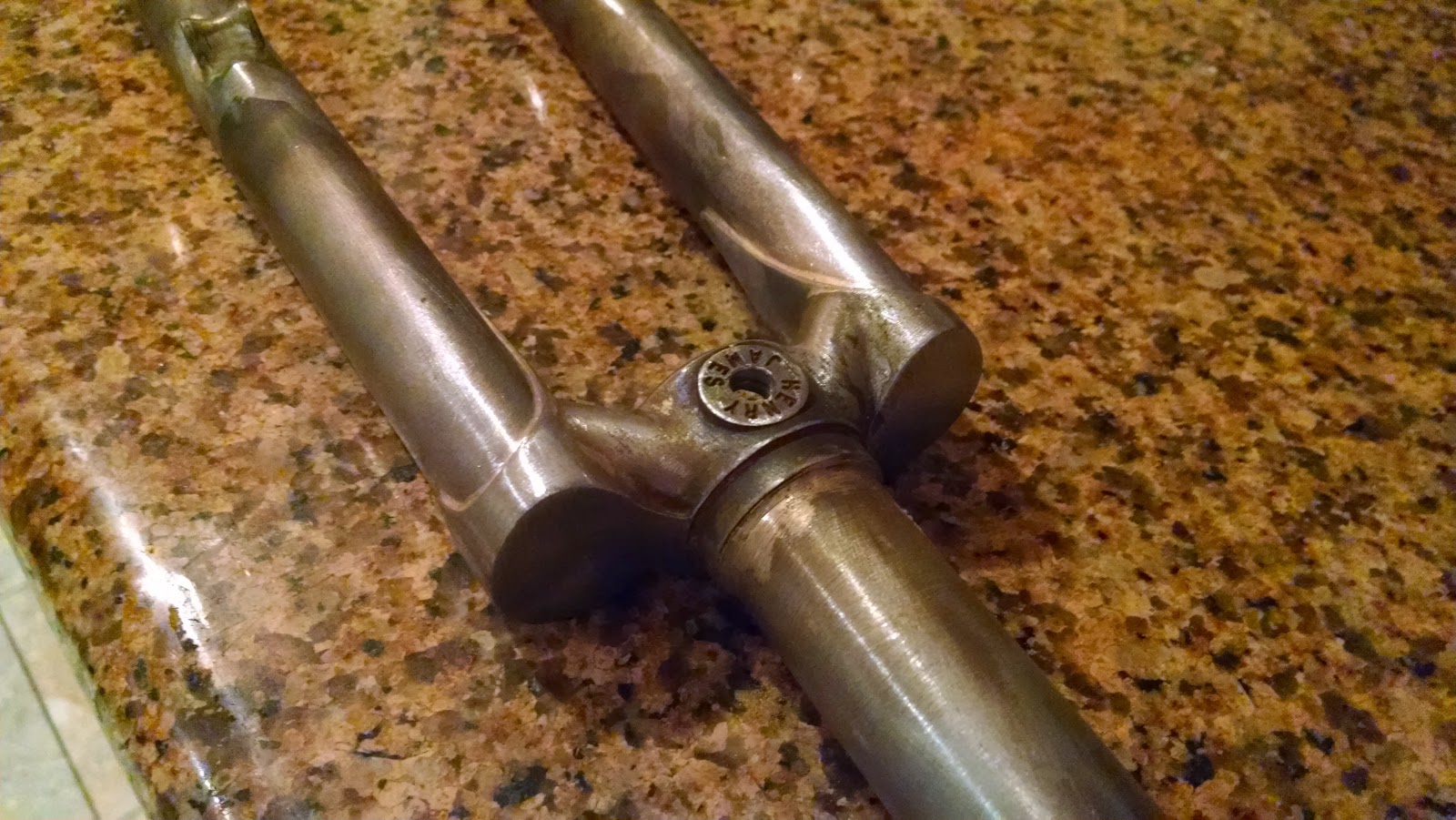

Here's the crown all cleaned up.  I love Henry James' crowns, they have this beautiful elegance to them.  I can't wait to see it with some paint on it.


I also love hourglass spindles.  I set these up to work with Nitto/Rivendell's Hub Area Rack.  It's a gorgeous piece of gear.  I can't imagine actually needing four bags for the kind of riding that I do... but WHAT IF? 

Worth mentioning: I used 50N for these rack mounts too.  Note the nice little fillet around the base of each of them.  


Here's the whole thing.  It needed a bit of a twist, but I've gotten it pretty straight. 


Bonus image: my co-blogger, Gimble.  She gets her own chair.


Saturday, November 22, 2014

Fork, Part 1

It's been a loooooong time.

Over the last couple of years, I finished the bike I was working on, made a sweet single speed, and rode them both a bunch.  I made a lot of progress with my brazing, but still count as a dangerous amateur.  

I've done a few practice forks, and I think this one will turn out well enough to bomb down big hills on.


First, I trimmed the fork down to the right diameter to fit the Llewellyn dropouts that I'm using.  Then I used my home-made blade bender to add a nice smooth bend.  The block was made for me by a coworker out of some scrap wood at his other job repairing boats.

I'm using 1.0/.66 True Temper blades.  As a Dangerous Amateur (tm), I really like these.  They bend easily and are pretty forgiving when I have to mess with them.  The folks at Henry James are always a pleasure to work with, and if I mess up I can get replacements pretty quickly.


48.5 mm rake on both blades, perfect!  The bends are also pretty close to perfectly in-plane.  Next step, fire!


For this bike, I have my own brazing setup.  It's oxy/propane, and the oxygen is drawn from the air by a medical oxygen concentration.  This way I don't have to deal with oxygen tanks or acetylene, and the slightly more diffuse flame that the propane makes actually feels a lot more natural for silver brazing.


I started by attaching the fork crown to the steerer tube.  I've gotten a lot more patient with practice and have stopped burning much flux.  I pulled through some excess silver, but a swipe or two with a stainless steel brush  while it was still hot got rid of most of it.  The rest should come off in a few minutes with emery cloth.


I didn't have time to start brazing the dropouts onto the fork, but I did spend a little time adjusting the jig.  I bought it from someone who'd already adapted it to accept an anvil axle, and with a few extra measurements, it turns out pretty awesome results.


Ok, it's been a while since I've written an entry, so I'm out of practice.  Please accept this blurry picture of a puppy I want to adopt as a show of contrition.

Monday, April 9, 2012

Cargo Rack, Part 2

In this series: Part 1Part 2Part 3Part 4.


Yesterday I started brazing the rack, which was pretty exciting.  In this step, I just laid down a bit of bronze to hold things in place.  Later, I'll build up fillets.  A fillet is a meniscus of metal that joins pieces together.  When done properly, the metal creates a nice smooth transition between the two.  

Tabs

I cut the tabs out of some sample sheets of chromoly steel that I had lying around.  They're basically little metal guitar picks.  When the bike is done and all of the attachment points are installed, I'll drill them.  That'll let me level it out if something weird happens.  


I'm pretty sure, but not positive, that the sheets will be thick enough to resist bending when I'm carrying things.  If I was using it for loaded touring, I'd double them up.  I still may add a bit of reinforcement.  

Once the tabs were done, I slotted the vertical tubes of the rack, lined them up with the tabs on my basic sketch, and then squeezed them with a pair of pliers just enough to keep them from shifting (much).  


Brazing

I started brazing by securing the tabs.  I did each of the four connections one at a time.  The hard part was dealing with the last joint.  It kept wanting to spring free, as the rack widens slightly near the rear (for aerodynamic effect, or something).   I solved that with the sheet-metal vice grips that appear in one of the pictures below. 


Next, I attached the rails, where a bag will hang.  I clamped the first on one end, rotated it level, then tacked it on the other.  Then I was able to remove the clamp and tack the remaining end.  


The second rail was about 100 times harder, since it had to line up exactly with the first.  At one point I probably would have hurled it across the room if there weren't other folks around working.  Thankfully, after quite a bit of trial and error, it fell into place and I was able to tack it down before it slipped and hit me in the eye or something.


Here we go!  I need to finish the fillets and grind the ends a bit, but the look and geometry work.  

Next time: finishing fillets, adding tabs for the wooden deck, and making the strut to connect it to the seat cluster.


In this series: Part 1Part 2Part 3Part 4.